
A Cenotaph as a Place of Memory: the Religious, Cultural, and Psychological Meaning of a Symbolic Grave
In brief: what is a cenotaph? A cenotaph is a symbolic grave, an empty tomb, or a memorial marker that does not contain the remains of the deceased. It is created in memory of a person or a group of people when the body is buried elsewhere, has not been found, has been lost, destroyed, or cannot be buried in the place where the family would like to have a site of remembrance.
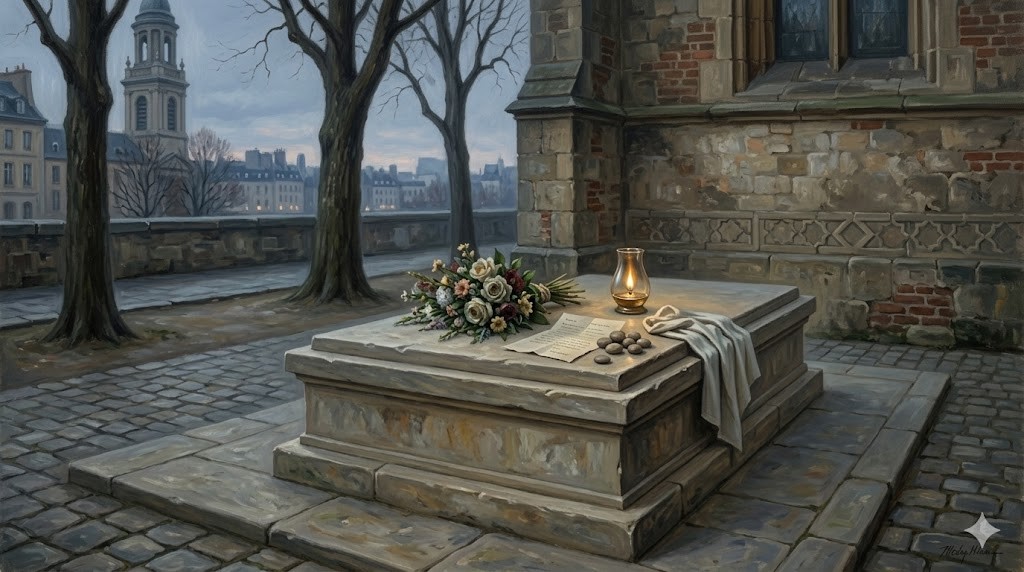
Simply put, a cenotaph is a place of memory without a body.
It is not meant to replace a real burial. Its purpose is to give the family, loved ones, or a community a place to come to: to lay flowers, light a candle, pray, say the person’s name, perform a ritual, remember them on the anniversary of their death, or mark an important family date.
A cenotaph can be especially important when someone has died in war, gone missing, been buried in another country, or become a victim of a disaster, repression, deportation, shipwreck, terrorist attack, mass violence, or another tragedy that left the family without an ordinary grave.
The central idea of a cenotaph is this:
The body is not here. But the memory is.
What does the word “cenotaph” mean?
The word cenotaph comes from the Greek meaning “empty tomb.” In modern usage, it refers to a monument, gravestone-like marker, memorial plaque, or architectural structure dedicated to a deceased person or group of people whose remains are not located at that site.
It is important to understand that a cenotaph is not a false grave and not an attempt to present a memorial as an actual burial. On the contrary, a properly designed cenotaph honestly shows that this is a symbolic place of remembrance, not the physical place of burial.
That is why cenotaph inscriptions often say:
“In memory of…”
“A symbolic place of remembrance…”
“Here we remember…”
“Place of burial unknown…”
“Buried elsewhere, but forever in our memory…”
How is a cenotaph different from a grave, a headstone, and a memorial?
These terms are often confused, so it is helpful to separate them clearly.
Term What it means Are the body or ashes there?
Grave The physical burial place of a person Yes
Headstone A memorial marker placed at a burial site Usually yes
Cenotaph A symbolic grave or memorial marker without remains No
Memorial A public place of remembrance, often collective Not necessarily
Memorial plaque A small sign of remembrance on a house, wall, church, park, or other place No
In other words, a grave is connected to the body or ashes. A cenotaph is connected to memory, name, and ritual, but not to the physical presence of remains.
A cenotaph may look like an ordinary headstone, but its meaning is different: there is no body beneath it. That is why, ethically and legally, it is important not to create the false impression that the person is buried there.
When is a cenotaph created?
A cenotaph may be appropriate when:
• the person’s body has not been found;
• the person is missing;
• the remains cannot be identified;
• the body was destroyed in a disaster, fire, explosion, war, or shipwreck;
• the person is buried in another country and the family cannot travel there;
• the real grave is far away or inaccessible;
• the cemetery has been destroyed, lost, or is located in occupied territory;
• a funeral was impossible;
• the person became a victim of mass violence, repression, deportation, or genocide;
• the family needs a place for prayer, remembrance, and ritual;
• children or teenagers need a clear, understandable place connected to the deceased;
• it is important to restore the person’s name to family or public history.
A cenotaph becomes especially meaningful when death was not only a personal loss, but also an event that deprived the family of a normal farewell.
Why does a family need a cenotaph?
When there is an ordinary grave, the family has a physical point of connection. A person can come there, stand in silence, bring flowers, pray, speak to the deceased, and feel that memory has a place.
When there is no body, when the grave is far away, or when the person has disappeared, grief often becomes suspended. The loss has no clear shape. The family knows the person is no longer present, but there is no place where that loss can be acknowledged, named, and lived through.
A cenotaph helps give grief a form.
It can become:
• a place of farewell;
• a place of family memory;
• a place of prayer;
• a place for anniversaries;
• a point of conversation with children;
• a way to acknowledge death when there was no ordinary funeral;
• a way to restore a person’s name;
• a way to say: “He existed. She existed. Their life mattered.”
A cenotaph is especially important in cases of uncertain, traumatic, or ritual-deprived death. It helps the family do what could not be done at the right time: create a place where memory can be expressed through action.
Cenotaphs and religion
Attitudes toward cenotaphs differ across religious traditions. Much depends on how a particular tradition understands the body, burial, prayer, memory, ritual, and the relationship between the living and the dead.
The general rule across all religions is this: a cenotaph should not replace the real burial place and should not mislead anyone. Ideally, it should be clearly marked as a place of memory, not as a grave containing remains.
Cenotaphs in Christianity
In Christianity, the body of the deceased matters because death is understood not only as a biological event, but also as something connected with human dignity, resurrection, prayer, and remembrance. At the same time, Christian tradition has always known many situations in which there is no body, the grave is unknown, or the person is buried far away.
For this reason, the idea of a cenotaph does not contradict Christian remembrance, as long as it is created honestly and respectfully.
In a Christian context, it is important to distinguish between:
the place where the remains are located
and
the place where remembrance takes place.
A cenotaph belongs to the second category. It can be a place where loved ones pray, light a candle, read names aloud, or come on the anniversary of death. But it should not present itself as an actual burial if the body is not there.
Suitable wording might include:
“In memory of…”
“A place of prayerful remembrance…”
“A symbolic grave…”
“Buried elsewhere, but remembered here…”
Cenotaphs in Orthodox Christianity
In Orthodox culture, remembrance of the dead, prayer, the person’s name, candles, memorial days, and connection with one’s family line all carry deep meaning. For this reason, a cenotaph may be understandable to an Orthodox family as a place of prayerful remembrance, especially when an ordinary grave is impossible.
For an Orthodox Christian, it is important that the deceased does not disappear from the memory of the family and community. The person’s name can be spoken in prayer, at home, in church, on memorial Saturdays, on anniversaries, at the cemetery, or near a memorial marker.
If there is no body, it is better not to design the cenotaph exactly like an ordinary grave, but rather as:
• a memorial marker;
• a symbolic place of remembrance;
• a place of prayerful commemoration;
• a family memorial plaque;
• an inscription within a family burial plot, with a clarification that the person is buried elsewhere or that the burial place is unknown.
Special care is needed when a person is missing and death has not been legally confirmed. In such cases, the family may need wording that does not “close” the story too harshly, but leaves space for hope and prayer:
“In prayerful memory…”
“Missing…”
“We wait, remember, and pray…”
Cenotaphs in Catholicism
In Catholic tradition, respectful treatment of the body and ashes of the deceased is very important. The Catholic Church emphasizes that remains should be kept in a sacred or specially designated place: a cemetery, church, or another approved location.
At the same time, a cenotaph can exist as a place of remembrance, provided it does not create confusion about where the remains are. For example, a person may be buried in one country, while an inscription “in memory of…” may be placed in a family chapel, on a memorial wall, or in a cemetery in another country.
In a Catholic context, it is especially important to:
• avoid confusing a real burial with a symbolic place;
• avoid claiming that the body is present where it is not;
• coordinate the form of the memorial with the rules of the cemetery or parish;
• keep the memorial respectful rather than ostentatious.
Cenotaphs in the Anglican tradition
In the Anglican tradition, especially in the United Kingdom, the cenotaph is a well-known public form of remembrance because of the Cenotaph on Whitehall in London. However, private memorial markers in churchyards may be strictly regulated.
This is an important example of the difference between civil, legal, and church contexts: a state war cenotaph may be a central national symbol, while a private “headstone without remains” in a churchyard may require special permission or may not be allowed in the form of an ordinary grave marker.
That is why, in church spaces, it is always necessary to clarify the rules in advance: whether a memorial marker is allowed, what wording may be used, and whether the form of a headstone is acceptable if no remains are buried in that plot.
Cenotaphs in Judaism
In Judaism, the memory of the name, respect for the dead, the connection between generations, and visiting graves all hold great significance. For this reason, a cenotaph can be especially important when a grave has been destroyed, is unknown, or does not exist.
After the Holocaust, many families were left in a situation where their loved ones had been murdered, but no burial place existed or the location was unknown. In such circumstances, a cenotaph can become a way to restore a person’s name and place within family memory.
This is especially meaningful in Jewish tradition because genocide was aimed not only at the physical destruction of people, but also at erasing their traces: names, homes, graves, and family lines.
In this context, a cenotaph is not a “replacement grave,” but an act of restoring memory:
this person lived;
they had a name;
they had a family;
they did not disappear from history.
Cenotaphs in Islam
In Islam, great importance is given to dignified treatment of the body, burial, modesty, and respect for the dead. Attitudes toward gravestones, monuments, and monumental structures can differ across Islamic cultures: in some communities, simple grave markers are accepted; in others, excessive monumentality is discouraged.
For a Muslim family, a cenotaph is therefore best understood not as an elaborate monument, but as a modest place of remembrance when the body is absent, buried far away, or the burial place is unknown.
It is especially important to consider:
• the tradition of the particular family;
• the opinion of a religious authority;
• cemetery rules;
• the need to avoid excessive display;
• clear and respectful wording that identifies the site as a memorial place.
A suitable form may be very simple: a stone, a plaque, a name, a date, a short prayerful phrase, and a place for quiet visitation.
A secular humanist view of cenotaphs
For non-religious people, a cenotaph may not be a place of prayer, but a place of connection, memory, and recognition.
It helps say:
“This person existed.”
“Their life mattered.”
“Their absence is noticed.”
“We will not allow this death to disappear into silence.”
In secular culture, cenotaphs are often connected with wars, disasters, political violence, migration, disappearances, mass tragedies, and public memory.
In this context, a cenotaph has not a religious function, but a human and cultural one: it restores a name to the place where there was loss.
Cultural, legal, and practical attitudes toward cenotaphs in Europe
Across Europe, cenotaphs and similar forms of remembrance are generally treated with respect. But legally and practically, everything depends on the specific country, municipality, cemetery, religious jurisdiction, and form of the memorial.
It is useful to distinguish between three situations.
1. A public or state cenotaph
This is a monument to those killed in war, victims of disaster, repression, deportation, genocide, terrorism, or mass violence.
Such memorials are often created by the state, a city, a community, a military organization, a church, a foundation, or relatives of the dead.
2. A private family cenotaph
This is a symbolic grave or memorial marker for a specific person — for example, someone buried in another country, missing, or whose body has not been found.
In this case, the rules of the particular cemetery almost always matter.
3. A memorial plaque or marker outside a cemetery
This may be a plaque on a house, a stone in a park, a roadside marker, a memorial slab in a church, a memorial bench, a tree of memory, or a small urban sign.
Such forms are governed by the rules of the city, landowner, religious community, or institution.
The United Kingdom: the cenotaph as a national symbol of memory
In the United Kingdom, the word cenotaph is widely known because of the Cenotaph on Whitehall in London. It is one of the country’s most important war memorials and a central place of national remembrance.
The British tradition of cenotaphs is especially connected with the First World War. Many soldiers who died were buried far from home or had no known grave. The cenotaph therefore became not a private oddity, but an important form of public mourning and national memory.
In practice, in the UK it is important to distinguish between:
• public war cenotaphs;
• monuments in municipal cemeteries;
• memorial markers in churchyards.
In church spaces, the rules can be strict. If the remains are not on the site, an ordinary headstone may be impossible or may require special permission.
France: returning the name of the dead to their hometown
In France, monuments aux morts — monuments to the dead, especially after the First World War — play an enormous role. They stand in countless towns and villages and often list the names of local residents who died in war.
The French approach is built around the name and civic recognition. Even if the body of the deceased is buried far away or has not been found, the person’s name is returned to the space of their hometown.
This is not always called a cenotaph, but functionally it often works in the same way: it creates a place where the community can remember its dead.
Legally, cemeteries and monuments in France are regulated by municipal rules. Military cemeteries, historic memorials, and protected sites of remembrance may have special legal status.
Germany: memory culture and small signs with great meaning
In Germany, memory is an especially sensitive subject because of the history of the twentieth century. German Erinnerungskultur, or culture of remembrance, is connected not only with honoring the dead, but also with responsibility, reflection on guilt, and remembrance of the victims of Nazism, the Holocaust, war, and dictatorships.
One of the most striking examples is the Stolpersteine, or “stumbling stones.” These are small brass plaques embedded in the pavement in front of the house where a person lived before deportation, persecution, or murder.
Formally, they are not classical cenotaphs, but psychologically and memorially they are close to them. They give a person a symbolic place of memory where an ordinary grave may not exist.
Their power lies precisely in their small scale: not a vast monument, but a name at the threshold of a home. A person receives an address, a biography, and a place in the city again.
Belgium: a collective cenotaph for thousands of unknown graves
One of the most powerful European examples is the Menin Gate Memorial in Ypres. It commemorates soldiers who died in the First World War and whose graves are unknown.
In meaning, it is a vast collective cenotaph: an architectural place of remembrance for thousands of people without individual graves.
What is especially important is that memory there is supported not only by stone, but also by ritual. Under the arch of the Menin Gate, the Last Post is played regularly as a musical ritual of remembrance. This shows that a cenotaph becomes stronger when it is not merely installed, but included in a living practice of commemoration.
Italy: family memory, chapels, and memorial inscriptions
Italy has a strong cemetery and family memorial culture: family vaults, niches, chapels, memorial plaques, photographs, flowers, and regular cemetery visits.
In Italy, a cenotaph may take the form of:
a separate memorial marker;
an inscription in a family chapel;
a memorial slab in a family burial place;
an urban memorial to victims of war, fascism, disaster, the sea, or migration;
a symbolic place of memory for someone buried in another region or country.
In a Catholic context, it is especially important to avoid confusion between the body, ashes, and a place of remembrance. For this reason, the wording “in memory of…” will often be more appropriate than an imitation of an ordinary burial.
Poland, Czechia, Slovakia, and the Balkans: memory of wars, deportations, and the disappeared
In Central and Eastern Europe, cenotaphs are often connected with wars, deportations, repression, mass killings, disappearances, and the loss of ancestral places.
Here the central idea is especially strong:
“There is no grave, but memory must have a place.”
In Poland, this may involve remembrance of victims of the Second World War, the Katyn massacre, uprisings, deportations, and political repression.
In the Balkans, it may involve remembrance of those killed or missing during the wars of the 1990s, ethnic cleansing, mass graves, and enforced disappearances.
In such cases, a cenotaph has not only a family function, but also a public one. It affirms that a person or group of people has not disappeared from history.
Ukraine: cenotaphs as the right to farewell in wartime
For Ukraine, the topic of cenotaphs is especially painful and urgent today. War, missing persons, the dead whose bodies have not been returned, destroyed cemeteries, forced migration, and the inability to reach a grave all make the cenotaph not a decorative form of memory, but a real human necessity.
A cenotaph may be created:
on a family cemetery plot if the body is buried elsewhere;
as a memorial plaque in a town or village;
as a temporary place of memory until the body is found;
as a permanent marker for someone whose grave is unknown;
as a collective memorial to the dead and missing;
as a place the family can visit when the real grave is inaccessible.
For Ukrainian families, a cenotaph can become a way to reclaim the right to ritual, even when war has taken away the possibility of an ordinary farewell.
Famous cenotaphs and related forms of remembrance in Europe
The Cenotaph, London
The Cenotaph on Whitehall in London is one of the most famous in the world. It became the main British symbol of remembrance for those killed in war.
It is an example of how an “empty tomb” can become a central national place of mourning, gratitude, and ritual commemoration.
Menin Gate, Ypres, Belgium
The Menin Gate is a memorial to soldiers with unknown graves. It shows that a cenotaph can be collective rather than individual: not one symbolic grave, but a place of memory for tens of thousands of people.
Stolpersteine, Germany and Europe
The “stumbling stones” return the names of victims of Nazism to the urban landscape. They are an example of how a small marker can function as a symbolic grave, especially when no real burial exists.
Monuments aux morts, France
French monuments to the dead return the names of the deceased to the towns and villages they came from. They are not always formal cenotaphs, but functionally they create a place of remembrance for those who died far from home.
The psychological impact of a cenotaph
A cenotaph can strongly affect the grieving process. It can help, but if handled poorly, it can also intensify pain. That is why it should be seen not only as a monument, but also as a psychological tool.
How a cenotaph can help
A cenotaph is especially helpful when grief has no form.
This can happen when:
death was sudden;
the body was not found;
the person is missing;
there was no funeral;
the person died far away;
the family cannot reach the real grave;
the circumstances of death were traumatic;
society did not recognize the loss;
loved ones have no place where memory can be expressed.
A cenotaph can help to:
acknowledge the reality of the loss;
reduce the feeling that the person “vanished without a trace”;
create a place for ritual;
give the family somewhere to come;
help children understand that memory can have a place;
restore the person’s name;
support a continuing bond with the deceased;
bring the family together around a gentle ritual;
give society a way to acknowledge tragedy;
reduce helplessness.
A cenotaph helps not by making people “let go and forget,” but by creating a new form of connection with the deceased. Modern understandings of grief increasingly recognize that the bond with the dead does not necessarily have to be broken. It can change and become part of life.
In this sense, a cenotaph can be a place of continuing connection: not a denial of death, but a way to go on living while preserving memory.
Why a place of memory matters for the psyche
Grief is not only a feeling. It is a process of rebuilding one’s inner reality.
A person gradually needs to accept several truths:
the deceased is no longer physically present;
the relationship with them will now be different;
life continues, but in a changed form;
memory can be preserved without destroying one’s own life.
Rituals help the psyche make this shift not only mentally, but physically: to come, see, touch, place flowers, light a candle, speak words, and be silent.
If there was no ritual, the psyche may remain in a state of incompletion for a long time. A cenotaph does not solve everything, but it can provide a point around which the work of grief can begin.
When a cenotaph can be harmful
A cenotaph does not automatically help. It can be painful or even harmful if it is created without taking the family’s emotional state into account.
Risks appear when:
• the family was pressured into creating a cenotaph before they were ready;
• the memorial was installed too early;
• the person is missing and part of the family still holds hope;
• relatives disagree about the status, wording, place, or form of the memorial;
• the cenotaph is used as a way to “close the subject” without allowing the family to grieve;
• the memorial becomes a place of constant self-punishment;
• a person goes there not for support, but to retraumatize themselves again and again;
• the inscription makes death sound definitively confirmed when legally or emotionally it is not;
• a public memorial politicizes the loss and pushes personal grief aside.
Cenotaphs for missing persons require particular care. For one family, a symbolic place of memory may be a relief. For another, it may feel like a betrayal of hope.
So the question should not be:
“Is a cenotaph needed at all?”
But rather:
“Is this particular family ready for this kind of place of memory, in this form, with this wording?”
Cenotaphs after traumatic loss
In traumatic loss, grief is often mixed with shock, fear, guilt, anger, helplessness, images of death, and the inability to accept what happened.
In such cases, a cenotaph may be helpful, but it should not be the only form of support.
A person may also need:
family support;
help from a psychologist or psychotherapist;
spiritual support;
a grief support group;
support from an end-of-life doula;
legal assistance;
help with questions around searching for the body, documents, legal status, or a missing person case.
A cenotaph is not therapy by itself. But it can become part of a careful process of recovery.
When a cenotaph is especially appropriate: a practical table
Situation Is a cenotaph appropriate? What to pay attention to
The body has not been found Yes The inscription should be honest and gentle
The grave is in another country Yes The real burial place can be mentioned
The person is missing With caution A “closing” form is not suitable for every family
The burial is inaccessible because of war Yes The cenotaph may be temporary or permanent
The family wants a place for prayer Yes It is important to respect the religious tradition
There is conflict between relatives With caution It is better to discuss the form and wording first
A child asks where the deceased is Yes, gently A place of memory can help explain the loss
The body is buried, but the family is far away Yes This can be a local place of remembrance
Death is not legally confirmed Very cautiously Softer wording is better
A public tragedy occurred Yes Public meaning should not erase personal grief
How to create a cenotaph with care
A good cenotaph should be honest, clear, and non-violent toward the family.
It should not force anyone to “close the story.” It should give people the possibility to remember.
What should be considered?
Before creating a cenotaph, it is worth discussing:
who it is being created for;
where it will be located;
who will be able to visit it;
whether it will be temporary or permanent;
which religious tradition matters to the family;
what will be written on it;
whether the wording may cause conflict;
whether it creates a false impression;
whether the family is ready for such a place of memory;
whether a specialist should be involved: a psychologist, clergy member, end-of-life doula, or lawyer.
What can be written on a cenotaph?
It is better to use wording that acknowledges memory without falsely claiming that a burial is present.
Suitable options include:
“In memory of…”
“A symbolic place of remembrance…”
“Here we remember…”
“Place of burial unknown…”
“Buried in…” - if the place is known.
“Missing…” - if death has not been confirmed.
“Forever in our memory…”
“Their name lives in the memory of the family…”
“Here is the place of our love and remembrance…”
For a military, civic, or public cenotaph, possible wording may include:
“To those whose graves are unknown…”
“To those who did not return…”
“To those who were denied an ordinary farewell…”
“The names are known. The graves are unknown. The memory lives.”
Wording to avoid
It is better not to write as if the body is there when it is not.
For example, the phrase:
“Here lies…”
may be inappropriate if there are no remains at that site.
Better alternatives include:
“Here we remember…”
“In memory of…”
“A place of remembrance…”
This is not only about legal accuracy. Clarity matters psychologically. A cenotaph should not create a new falsehood. It should offer honest support.
Can a cenotaph be placed in a cemetery?
In many cases, yes — but it depends on the rules of the specific cemetery, country, municipality, and religious jurisdiction.
Before placing a cenotaph, it is important to clarify:
whether the cemetery allows memorial markers without burial;
whether an ordinary headstone form may be used;
whether special permission is required;
which inscriptions are allowed;
whether a cenotaph can be placed on a family plot;
whether it must state that it is a symbolic grave;
whether there are religious restrictions;
who has the right to make the decision on behalf of the family.
In church spaces, requirements may be stricter than in municipal cemeteries. In some cases, instead of a headstone without remains, a memorial plaque, an inscription on a memorial wall, a memorial bench, a tree of memory, or another form may be allowed.
A cenotaph as part of supporting a grieving family
For an end-of-life doula, psychologist, priest, chaplain, social worker, or volunteer, the topic of cenotaphs is not simply about “a monument.” It is about an unfinished ritual.
When a family cannot bury a person, they often need alternative actions:
• to create a place of memory;
• to write a letter to the deceased;
• to hold a family ritual;
• to gather photographs and stories;
• to plant a tree;
• to create a memorial page;
• to light a candle on a particular day;
• to come to a symbolic place;
• to say the person’s name aloud;
• to include the deceased in family history.
A cenotaph can become the central point of that process.
But it is important to remember: a specialist should not impose a cenotaph. Their task is to help the family understand that this possibility exists and gently explore whether it is right for them.
FAQ: common questions about cenotaphs
What is a cenotaph in simple words?
A cenotaph is a symbolic grave or memorial marker without the body of the deceased. It is created when a person is buried elsewhere, the body has not been found, the grave is unknown, or an ordinary burial is impossible.
Is a cenotaph a real grave?
No. A real grave is the place where the body or ashes are located. A cenotaph is a place of memory without remains.
Why is a cenotaph needed if the body is not there?
A cenotaph is needed by the living. It gives the family a place to come to, lay flowers, pray, speak to the deceased, perform a ritual, and feel that the loss has been acknowledged.
Can a cenotaph be created for someone buried in another country?
Yes, if the rules of the cemetery or location allow it. In that case, it is important to state honestly that this is a place of memory, not the actual burial site.
Can a cenotaph be created if a person is missing?
Yes, but very carefully. If death has not been confirmed, softer wording is better: “in prayerful memory,” “missing,” “we remember and wait.” A family should not be forced to accept death as final if they are not ready.
Can Orthodox Christians have a cenotaph?
In Orthodox culture, prayer, the name, and commemoration are deeply important. A symbolic place of memory may therefore be appropriate, especially when there is no body or the grave is inaccessible. But it is better to present it as a memorial marker or a place of prayerful remembrance, not as an ordinary grave with a misleading inscription.
Can Muslims have a cenotaph?
In Islamic tradition, modesty, dignified burial, and respect for the dead are very important. Whether a cenotaph is appropriate depends on the family, community, and religious authority. If one is created, a simple and modest form is usually best.
How is a cenotaph different from a memorial?
A cenotaph is usually connected with a specific person or group whose remains are not present at that place. A memorial is a broader concept: it can be any public place of remembrance, and it does not necessarily resemble a grave.
Can a cenotaph help with grief?
Yes, in many cases it can. A cenotaph gives grief a form, creates a place for ritual, helps acknowledge the loss, and supports a continuing bond with the deceased. But it must be created gently and should never be forced on the family.
Can a cenotaph cause harm?
Yes, if it is created too early, against the family’s wishes, with inappropriate wording, or in a situation where death has not yet been confirmed. A cenotaph should support people, not force them to close their grief.
What is the best wording for a cenotaph?
It is better to write:
“In memory of…”
“Here we remember…”
“A symbolic place of remembrance…”
“Place of burial unknown…”
“Buried elsewhere…”
It is usually better to avoid “Here lies…” if the body or ashes are not actually there.
Final thought
A cenotaph is not just a monument, and it is not an “empty grave” in the everyday sense. It is a place for a loss that has no ordinary place.
It is especially important when death was distant, wartime, violent, uncertain, or deprived of a normal ritual. Different religions and cultures may approach cenotaphs differently, but the human need for a place of memory is universal.
A cenotaph can help a person grieve, pray, speak to the deceased, preserve a bond, restore a name, and create a ritual. But it must be created with care: without pressure, without falsehood, without replacing reality, and with respect for the family, religion, law, and the psychological state of the bereaved.
A cenotaph does not say:
“The body is here.”
It says:
“Memory is here.”
And sometimes, that is the first step toward making a silent loss speak.
It is not meant to replace a real burial. Its purpose is to give the family, loved ones, or a community a place to come to: to lay flowers, light a candle, pray, say the person’s name, perform a ritual, remember them on the anniversary of their death, or mark an important family date.
A cenotaph can be especially important when someone has died in war, gone missing, been buried in another country, or become a victim of a disaster, repression, deportation, shipwreck, terrorist attack, mass violence, or another tragedy that left the family without an ordinary grave.
The central idea of a cenotaph is this:
The body is not here. But the memory is.
What does the word “cenotaph” mean?
The word cenotaph comes from the Greek meaning “empty tomb.” In modern usage, it refers to a monument, gravestone-like marker, memorial plaque, or architectural structure dedicated to a deceased person or group of people whose remains are not located at that site.
It is important to understand that a cenotaph is not a false grave and not an attempt to present a memorial as an actual burial. On the contrary, a properly designed cenotaph honestly shows that this is a symbolic place of remembrance, not the physical place of burial.
That is why cenotaph inscriptions often say:
“In memory of…”
“A symbolic place of remembrance…”
“Here we remember…”
“Place of burial unknown…”
“Buried elsewhere, but forever in our memory…”
How is a cenotaph different from a grave, a headstone, and a memorial?
These terms are often confused, so it is helpful to separate them clearly.
Term What it means Are the body or ashes there?
Grave The physical burial place of a person Yes
Headstone A memorial marker placed at a burial site Usually yes
Cenotaph A symbolic grave or memorial marker without remains No
Memorial A public place of remembrance, often collective Not necessarily
Memorial plaque A small sign of remembrance on a house, wall, church, park, or other place No
In other words, a grave is connected to the body or ashes. A cenotaph is connected to memory, name, and ritual, but not to the physical presence of remains.
A cenotaph may look like an ordinary headstone, but its meaning is different: there is no body beneath it. That is why, ethically and legally, it is important not to create the false impression that the person is buried there.
When is a cenotaph created?
A cenotaph may be appropriate when:
• the person’s body has not been found;
• the person is missing;
• the remains cannot be identified;
• the body was destroyed in a disaster, fire, explosion, war, or shipwreck;
• the person is buried in another country and the family cannot travel there;
• the real grave is far away or inaccessible;
• the cemetery has been destroyed, lost, or is located in occupied territory;
• a funeral was impossible;
• the person became a victim of mass violence, repression, deportation, or genocide;
• the family needs a place for prayer, remembrance, and ritual;
• children or teenagers need a clear, understandable place connected to the deceased;
• it is important to restore the person’s name to family or public history.
A cenotaph becomes especially meaningful when death was not only a personal loss, but also an event that deprived the family of a normal farewell.
Why does a family need a cenotaph?
When there is an ordinary grave, the family has a physical point of connection. A person can come there, stand in silence, bring flowers, pray, speak to the deceased, and feel that memory has a place.
When there is no body, when the grave is far away, or when the person has disappeared, grief often becomes suspended. The loss has no clear shape. The family knows the person is no longer present, but there is no place where that loss can be acknowledged, named, and lived through.
A cenotaph helps give grief a form.
It can become:
• a place of farewell;
• a place of family memory;
• a place of prayer;
• a place for anniversaries;
• a point of conversation with children;
• a way to acknowledge death when there was no ordinary funeral;
• a way to restore a person’s name;
• a way to say: “He existed. She existed. Their life mattered.”
A cenotaph is especially important in cases of uncertain, traumatic, or ritual-deprived death. It helps the family do what could not be done at the right time: create a place where memory can be expressed through action.
Cenotaphs and religion
Attitudes toward cenotaphs differ across religious traditions. Much depends on how a particular tradition understands the body, burial, prayer, memory, ritual, and the relationship between the living and the dead.
The general rule across all religions is this: a cenotaph should not replace the real burial place and should not mislead anyone. Ideally, it should be clearly marked as a place of memory, not as a grave containing remains.
Cenotaphs in Christianity
In Christianity, the body of the deceased matters because death is understood not only as a biological event, but also as something connected with human dignity, resurrection, prayer, and remembrance. At the same time, Christian tradition has always known many situations in which there is no body, the grave is unknown, or the person is buried far away.
For this reason, the idea of a cenotaph does not contradict Christian remembrance, as long as it is created honestly and respectfully.
In a Christian context, it is important to distinguish between:
the place where the remains are located
and
the place where remembrance takes place.
A cenotaph belongs to the second category. It can be a place where loved ones pray, light a candle, read names aloud, or come on the anniversary of death. But it should not present itself as an actual burial if the body is not there.
Suitable wording might include:
“In memory of…”
“A place of prayerful remembrance…”
“A symbolic grave…”
“Buried elsewhere, but remembered here…”
Cenotaphs in Orthodox Christianity
In Orthodox culture, remembrance of the dead, prayer, the person’s name, candles, memorial days, and connection with one’s family line all carry deep meaning. For this reason, a cenotaph may be understandable to an Orthodox family as a place of prayerful remembrance, especially when an ordinary grave is impossible.
For an Orthodox Christian, it is important that the deceased does not disappear from the memory of the family and community. The person’s name can be spoken in prayer, at home, in church, on memorial Saturdays, on anniversaries, at the cemetery, or near a memorial marker.
If there is no body, it is better not to design the cenotaph exactly like an ordinary grave, but rather as:
• a memorial marker;
• a symbolic place of remembrance;
• a place of prayerful commemoration;
• a family memorial plaque;
• an inscription within a family burial plot, with a clarification that the person is buried elsewhere or that the burial place is unknown.
Special care is needed when a person is missing and death has not been legally confirmed. In such cases, the family may need wording that does not “close” the story too harshly, but leaves space for hope and prayer:
“In prayerful memory…”
“Missing…”
“We wait, remember, and pray…”
Cenotaphs in Catholicism
In Catholic tradition, respectful treatment of the body and ashes of the deceased is very important. The Catholic Church emphasizes that remains should be kept in a sacred or specially designated place: a cemetery, church, or another approved location.
At the same time, a cenotaph can exist as a place of remembrance, provided it does not create confusion about where the remains are. For example, a person may be buried in one country, while an inscription “in memory of…” may be placed in a family chapel, on a memorial wall, or in a cemetery in another country.
In a Catholic context, it is especially important to:
• avoid confusing a real burial with a symbolic place;
• avoid claiming that the body is present where it is not;
• coordinate the form of the memorial with the rules of the cemetery or parish;
• keep the memorial respectful rather than ostentatious.
Cenotaphs in the Anglican tradition
In the Anglican tradition, especially in the United Kingdom, the cenotaph is a well-known public form of remembrance because of the Cenotaph on Whitehall in London. However, private memorial markers in churchyards may be strictly regulated.
This is an important example of the difference between civil, legal, and church contexts: a state war cenotaph may be a central national symbol, while a private “headstone without remains” in a churchyard may require special permission or may not be allowed in the form of an ordinary grave marker.
That is why, in church spaces, it is always necessary to clarify the rules in advance: whether a memorial marker is allowed, what wording may be used, and whether the form of a headstone is acceptable if no remains are buried in that plot.
Cenotaphs in Judaism
In Judaism, the memory of the name, respect for the dead, the connection between generations, and visiting graves all hold great significance. For this reason, a cenotaph can be especially important when a grave has been destroyed, is unknown, or does not exist.
After the Holocaust, many families were left in a situation where their loved ones had been murdered, but no burial place existed or the location was unknown. In such circumstances, a cenotaph can become a way to restore a person’s name and place within family memory.
This is especially meaningful in Jewish tradition because genocide was aimed not only at the physical destruction of people, but also at erasing their traces: names, homes, graves, and family lines.
In this context, a cenotaph is not a “replacement grave,” but an act of restoring memory:
this person lived;
they had a name;
they had a family;
they did not disappear from history.
Cenotaphs in Islam
In Islam, great importance is given to dignified treatment of the body, burial, modesty, and respect for the dead. Attitudes toward gravestones, monuments, and monumental structures can differ across Islamic cultures: in some communities, simple grave markers are accepted; in others, excessive monumentality is discouraged.
For a Muslim family, a cenotaph is therefore best understood not as an elaborate monument, but as a modest place of remembrance when the body is absent, buried far away, or the burial place is unknown.
It is especially important to consider:
• the tradition of the particular family;
• the opinion of a religious authority;
• cemetery rules;
• the need to avoid excessive display;
• clear and respectful wording that identifies the site as a memorial place.
A suitable form may be very simple: a stone, a plaque, a name, a date, a short prayerful phrase, and a place for quiet visitation.
A secular humanist view of cenotaphs
For non-religious people, a cenotaph may not be a place of prayer, but a place of connection, memory, and recognition.
It helps say:
“This person existed.”
“Their life mattered.”
“Their absence is noticed.”
“We will not allow this death to disappear into silence.”
In secular culture, cenotaphs are often connected with wars, disasters, political violence, migration, disappearances, mass tragedies, and public memory.
In this context, a cenotaph has not a religious function, but a human and cultural one: it restores a name to the place where there was loss.
Cultural, legal, and practical attitudes toward cenotaphs in Europe
Across Europe, cenotaphs and similar forms of remembrance are generally treated with respect. But legally and practically, everything depends on the specific country, municipality, cemetery, religious jurisdiction, and form of the memorial.
It is useful to distinguish between three situations.
1. A public or state cenotaph
This is a monument to those killed in war, victims of disaster, repression, deportation, genocide, terrorism, or mass violence.
Such memorials are often created by the state, a city, a community, a military organization, a church, a foundation, or relatives of the dead.
2. A private family cenotaph
This is a symbolic grave or memorial marker for a specific person — for example, someone buried in another country, missing, or whose body has not been found.
In this case, the rules of the particular cemetery almost always matter.
3. A memorial plaque or marker outside a cemetery
This may be a plaque on a house, a stone in a park, a roadside marker, a memorial slab in a church, a memorial bench, a tree of memory, or a small urban sign.
Such forms are governed by the rules of the city, landowner, religious community, or institution.
The United Kingdom: the cenotaph as a national symbol of memory
In the United Kingdom, the word cenotaph is widely known because of the Cenotaph on Whitehall in London. It is one of the country’s most important war memorials and a central place of national remembrance.
The British tradition of cenotaphs is especially connected with the First World War. Many soldiers who died were buried far from home or had no known grave. The cenotaph therefore became not a private oddity, but an important form of public mourning and national memory.
In practice, in the UK it is important to distinguish between:
• public war cenotaphs;
• monuments in municipal cemeteries;
• memorial markers in churchyards.
In church spaces, the rules can be strict. If the remains are not on the site, an ordinary headstone may be impossible or may require special permission.
France: returning the name of the dead to their hometown
In France, monuments aux morts — monuments to the dead, especially after the First World War — play an enormous role. They stand in countless towns and villages and often list the names of local residents who died in war.
The French approach is built around the name and civic recognition. Even if the body of the deceased is buried far away or has not been found, the person’s name is returned to the space of their hometown.
This is not always called a cenotaph, but functionally it often works in the same way: it creates a place where the community can remember its dead.
Legally, cemeteries and monuments in France are regulated by municipal rules. Military cemeteries, historic memorials, and protected sites of remembrance may have special legal status.
Germany: memory culture and small signs with great meaning
In Germany, memory is an especially sensitive subject because of the history of the twentieth century. German Erinnerungskultur, or culture of remembrance, is connected not only with honoring the dead, but also with responsibility, reflection on guilt, and remembrance of the victims of Nazism, the Holocaust, war, and dictatorships.
One of the most striking examples is the Stolpersteine, or “stumbling stones.” These are small brass plaques embedded in the pavement in front of the house where a person lived before deportation, persecution, or murder.
Formally, they are not classical cenotaphs, but psychologically and memorially they are close to them. They give a person a symbolic place of memory where an ordinary grave may not exist.
Their power lies precisely in their small scale: not a vast monument, but a name at the threshold of a home. A person receives an address, a biography, and a place in the city again.
Belgium: a collective cenotaph for thousands of unknown graves
One of the most powerful European examples is the Menin Gate Memorial in Ypres. It commemorates soldiers who died in the First World War and whose graves are unknown.
In meaning, it is a vast collective cenotaph: an architectural place of remembrance for thousands of people without individual graves.
What is especially important is that memory there is supported not only by stone, but also by ritual. Under the arch of the Menin Gate, the Last Post is played regularly as a musical ritual of remembrance. This shows that a cenotaph becomes stronger when it is not merely installed, but included in a living practice of commemoration.
Italy: family memory, chapels, and memorial inscriptions
Italy has a strong cemetery and family memorial culture: family vaults, niches, chapels, memorial plaques, photographs, flowers, and regular cemetery visits.
In Italy, a cenotaph may take the form of:
a separate memorial marker;
an inscription in a family chapel;
a memorial slab in a family burial place;
an urban memorial to victims of war, fascism, disaster, the sea, or migration;
a symbolic place of memory for someone buried in another region or country.
In a Catholic context, it is especially important to avoid confusion between the body, ashes, and a place of remembrance. For this reason, the wording “in memory of…” will often be more appropriate than an imitation of an ordinary burial.
Poland, Czechia, Slovakia, and the Balkans: memory of wars, deportations, and the disappeared
In Central and Eastern Europe, cenotaphs are often connected with wars, deportations, repression, mass killings, disappearances, and the loss of ancestral places.
Here the central idea is especially strong:
“There is no grave, but memory must have a place.”
In Poland, this may involve remembrance of victims of the Second World War, the Katyn massacre, uprisings, deportations, and political repression.
In the Balkans, it may involve remembrance of those killed or missing during the wars of the 1990s, ethnic cleansing, mass graves, and enforced disappearances.
In such cases, a cenotaph has not only a family function, but also a public one. It affirms that a person or group of people has not disappeared from history.
Ukraine: cenotaphs as the right to farewell in wartime
For Ukraine, the topic of cenotaphs is especially painful and urgent today. War, missing persons, the dead whose bodies have not been returned, destroyed cemeteries, forced migration, and the inability to reach a grave all make the cenotaph not a decorative form of memory, but a real human necessity.
A cenotaph may be created:
on a family cemetery plot if the body is buried elsewhere;
as a memorial plaque in a town or village;
as a temporary place of memory until the body is found;
as a permanent marker for someone whose grave is unknown;
as a collective memorial to the dead and missing;
as a place the family can visit when the real grave is inaccessible.
For Ukrainian families, a cenotaph can become a way to reclaim the right to ritual, even when war has taken away the possibility of an ordinary farewell.
Famous cenotaphs and related forms of remembrance in Europe
The Cenotaph, London
The Cenotaph on Whitehall in London is one of the most famous in the world. It became the main British symbol of remembrance for those killed in war.
It is an example of how an “empty tomb” can become a central national place of mourning, gratitude, and ritual commemoration.
Menin Gate, Ypres, Belgium
The Menin Gate is a memorial to soldiers with unknown graves. It shows that a cenotaph can be collective rather than individual: not one symbolic grave, but a place of memory for tens of thousands of people.
Stolpersteine, Germany and Europe
The “stumbling stones” return the names of victims of Nazism to the urban landscape. They are an example of how a small marker can function as a symbolic grave, especially when no real burial exists.
Monuments aux morts, France
French monuments to the dead return the names of the deceased to the towns and villages they came from. They are not always formal cenotaphs, but functionally they create a place of remembrance for those who died far from home.
The psychological impact of a cenotaph
A cenotaph can strongly affect the grieving process. It can help, but if handled poorly, it can also intensify pain. That is why it should be seen not only as a monument, but also as a psychological tool.
How a cenotaph can help
A cenotaph is especially helpful when grief has no form.
This can happen when:
death was sudden;
the body was not found;
the person is missing;
there was no funeral;
the person died far away;
the family cannot reach the real grave;
the circumstances of death were traumatic;
society did not recognize the loss;
loved ones have no place where memory can be expressed.
A cenotaph can help to:
acknowledge the reality of the loss;
reduce the feeling that the person “vanished without a trace”;
create a place for ritual;
give the family somewhere to come;
help children understand that memory can have a place;
restore the person’s name;
support a continuing bond with the deceased;
bring the family together around a gentle ritual;
give society a way to acknowledge tragedy;
reduce helplessness.
A cenotaph helps not by making people “let go and forget,” but by creating a new form of connection with the deceased. Modern understandings of grief increasingly recognize that the bond with the dead does not necessarily have to be broken. It can change and become part of life.
In this sense, a cenotaph can be a place of continuing connection: not a denial of death, but a way to go on living while preserving memory.
Why a place of memory matters for the psyche
Grief is not only a feeling. It is a process of rebuilding one’s inner reality.
A person gradually needs to accept several truths:
the deceased is no longer physically present;
the relationship with them will now be different;
life continues, but in a changed form;
memory can be preserved without destroying one’s own life.
Rituals help the psyche make this shift not only mentally, but physically: to come, see, touch, place flowers, light a candle, speak words, and be silent.
If there was no ritual, the psyche may remain in a state of incompletion for a long time. A cenotaph does not solve everything, but it can provide a point around which the work of grief can begin.
When a cenotaph can be harmful
A cenotaph does not automatically help. It can be painful or even harmful if it is created without taking the family’s emotional state into account.
Risks appear when:
• the family was pressured into creating a cenotaph before they were ready;
• the memorial was installed too early;
• the person is missing and part of the family still holds hope;
• relatives disagree about the status, wording, place, or form of the memorial;
• the cenotaph is used as a way to “close the subject” without allowing the family to grieve;
• the memorial becomes a place of constant self-punishment;
• a person goes there not for support, but to retraumatize themselves again and again;
• the inscription makes death sound definitively confirmed when legally or emotionally it is not;
• a public memorial politicizes the loss and pushes personal grief aside.
Cenotaphs for missing persons require particular care. For one family, a symbolic place of memory may be a relief. For another, it may feel like a betrayal of hope.
So the question should not be:
“Is a cenotaph needed at all?”
But rather:
“Is this particular family ready for this kind of place of memory, in this form, with this wording?”
Cenotaphs after traumatic loss
In traumatic loss, grief is often mixed with shock, fear, guilt, anger, helplessness, images of death, and the inability to accept what happened.
In such cases, a cenotaph may be helpful, but it should not be the only form of support.
A person may also need:
family support;
help from a psychologist or psychotherapist;
spiritual support;
a grief support group;
support from an end-of-life doula;
legal assistance;
help with questions around searching for the body, documents, legal status, or a missing person case.
A cenotaph is not therapy by itself. But it can become part of a careful process of recovery.
When a cenotaph is especially appropriate: a practical table
Situation Is a cenotaph appropriate? What to pay attention to
The body has not been found Yes The inscription should be honest and gentle
The grave is in another country Yes The real burial place can be mentioned
The person is missing With caution A “closing” form is not suitable for every family
The burial is inaccessible because of war Yes The cenotaph may be temporary or permanent
The family wants a place for prayer Yes It is important to respect the religious tradition
There is conflict between relatives With caution It is better to discuss the form and wording first
A child asks where the deceased is Yes, gently A place of memory can help explain the loss
The body is buried, but the family is far away Yes This can be a local place of remembrance
Death is not legally confirmed Very cautiously Softer wording is better
A public tragedy occurred Yes Public meaning should not erase personal grief
How to create a cenotaph with care
A good cenotaph should be honest, clear, and non-violent toward the family.
It should not force anyone to “close the story.” It should give people the possibility to remember.
What should be considered?
Before creating a cenotaph, it is worth discussing:
who it is being created for;
where it will be located;
who will be able to visit it;
whether it will be temporary or permanent;
which religious tradition matters to the family;
what will be written on it;
whether the wording may cause conflict;
whether it creates a false impression;
whether the family is ready for such a place of memory;
whether a specialist should be involved: a psychologist, clergy member, end-of-life doula, or lawyer.
What can be written on a cenotaph?
It is better to use wording that acknowledges memory without falsely claiming that a burial is present.
Suitable options include:
“In memory of…”
“A symbolic place of remembrance…”
“Here we remember…”
“Place of burial unknown…”
“Buried in…” - if the place is known.
“Missing…” - if death has not been confirmed.
“Forever in our memory…”
“Their name lives in the memory of the family…”
“Here is the place of our love and remembrance…”
For a military, civic, or public cenotaph, possible wording may include:
“To those whose graves are unknown…”
“To those who did not return…”
“To those who were denied an ordinary farewell…”
“The names are known. The graves are unknown. The memory lives.”
Wording to avoid
It is better not to write as if the body is there when it is not.
For example, the phrase:
“Here lies…”
may be inappropriate if there are no remains at that site.
Better alternatives include:
“Here we remember…”
“In memory of…”
“A place of remembrance…”
This is not only about legal accuracy. Clarity matters psychologically. A cenotaph should not create a new falsehood. It should offer honest support.
Can a cenotaph be placed in a cemetery?
In many cases, yes — but it depends on the rules of the specific cemetery, country, municipality, and religious jurisdiction.
Before placing a cenotaph, it is important to clarify:
whether the cemetery allows memorial markers without burial;
whether an ordinary headstone form may be used;
whether special permission is required;
which inscriptions are allowed;
whether a cenotaph can be placed on a family plot;
whether it must state that it is a symbolic grave;
whether there are religious restrictions;
who has the right to make the decision on behalf of the family.
In church spaces, requirements may be stricter than in municipal cemeteries. In some cases, instead of a headstone without remains, a memorial plaque, an inscription on a memorial wall, a memorial bench, a tree of memory, or another form may be allowed.
A cenotaph as part of supporting a grieving family
For an end-of-life doula, psychologist, priest, chaplain, social worker, or volunteer, the topic of cenotaphs is not simply about “a monument.” It is about an unfinished ritual.
When a family cannot bury a person, they often need alternative actions:
• to create a place of memory;
• to write a letter to the deceased;
• to hold a family ritual;
• to gather photographs and stories;
• to plant a tree;
• to create a memorial page;
• to light a candle on a particular day;
• to come to a symbolic place;
• to say the person’s name aloud;
• to include the deceased in family history.
A cenotaph can become the central point of that process.
But it is important to remember: a specialist should not impose a cenotaph. Their task is to help the family understand that this possibility exists and gently explore whether it is right for them.
FAQ: common questions about cenotaphs
What is a cenotaph in simple words?
A cenotaph is a symbolic grave or memorial marker without the body of the deceased. It is created when a person is buried elsewhere, the body has not been found, the grave is unknown, or an ordinary burial is impossible.
Is a cenotaph a real grave?
No. A real grave is the place where the body or ashes are located. A cenotaph is a place of memory without remains.
Why is a cenotaph needed if the body is not there?
A cenotaph is needed by the living. It gives the family a place to come to, lay flowers, pray, speak to the deceased, perform a ritual, and feel that the loss has been acknowledged.
Can a cenotaph be created for someone buried in another country?
Yes, if the rules of the cemetery or location allow it. In that case, it is important to state honestly that this is a place of memory, not the actual burial site.
Can a cenotaph be created if a person is missing?
Yes, but very carefully. If death has not been confirmed, softer wording is better: “in prayerful memory,” “missing,” “we remember and wait.” A family should not be forced to accept death as final if they are not ready.
Can Orthodox Christians have a cenotaph?
In Orthodox culture, prayer, the name, and commemoration are deeply important. A symbolic place of memory may therefore be appropriate, especially when there is no body or the grave is inaccessible. But it is better to present it as a memorial marker or a place of prayerful remembrance, not as an ordinary grave with a misleading inscription.
Can Muslims have a cenotaph?
In Islamic tradition, modesty, dignified burial, and respect for the dead are very important. Whether a cenotaph is appropriate depends on the family, community, and religious authority. If one is created, a simple and modest form is usually best.
How is a cenotaph different from a memorial?
A cenotaph is usually connected with a specific person or group whose remains are not present at that place. A memorial is a broader concept: it can be any public place of remembrance, and it does not necessarily resemble a grave.
Can a cenotaph help with grief?
Yes, in many cases it can. A cenotaph gives grief a form, creates a place for ritual, helps acknowledge the loss, and supports a continuing bond with the deceased. But it must be created gently and should never be forced on the family.
Can a cenotaph cause harm?
Yes, if it is created too early, against the family’s wishes, with inappropriate wording, or in a situation where death has not yet been confirmed. A cenotaph should support people, not force them to close their grief.
What is the best wording for a cenotaph?
It is better to write:
“In memory of…”
“Here we remember…”
“A symbolic place of remembrance…”
“Place of burial unknown…”
“Buried elsewhere…”
It is usually better to avoid “Here lies…” if the body or ashes are not actually there.
Final thought
A cenotaph is not just a monument, and it is not an “empty grave” in the everyday sense. It is a place for a loss that has no ordinary place.
It is especially important when death was distant, wartime, violent, uncertain, or deprived of a normal ritual. Different religions and cultures may approach cenotaphs differently, but the human need for a place of memory is universal.
A cenotaph can help a person grieve, pray, speak to the deceased, preserve a bond, restore a name, and create a ritual. But it must be created with care: without pressure, without falsehood, without replacing reality, and with respect for the family, religion, law, and the psychological state of the bereaved.
A cenotaph does not say:
“The body is here.”
It says:
“Memory is here.”
And sometimes, that is the first step toward making a silent loss speak.